Death by a Billion Prototypes (I-V)
A Manifesto for the Age of AI Autonomy. What will you build?
I. THE ILLUSION OF CONTROL
They sold us technology as a solution. They said it would solve our problems—connect us, empower us, free us.
But here we are, clicking through a labyrinth of unintelligible icons, drowning in update notifications, navigating designs that were once intuitive but now feel like puzzles rigged for someone else's promotion.
Technology was never about solving problems; it was about controlling them. And we bought in—because control feels like progress, and progress feels like victory.
But let’s be honest: we hate using technology.
We crave the benefits, but despise the friction.
We endure the learning curves, but resent the constant churn.
We adapt to every "redesign," every "feature enhancement," knowing deep down that nothing good lasts long in the hands of product managers chasing their next career milestone.
Enter AI—the great seduction. The smooth-talking assistant that listens, that understands, that acts. It offers the ultimate illusion of control. We no longer have to fight through menus or decipher cryptic icons; we just ask. We summon worlds, command tasks, and it obeys. AI is the perfect interface, because it is the interface.
But herein lies the paradox: the more we control, the less we engage.
And the less we engage, the more we surrender.
II. THE PRISONER’S DILEMMA OF PROGRESS
We stand at a precipice, staring into the abyss of inevitability.
The choice is stark:
- Keep fighting the broken systems, the half-baked designs, the exhausting friction of modern technology.
- Or let AI take the wheel—let it filter, organize, automate, simplify.
It’s an easy decision, right? AI gives us everything we want, and more. We get to keep our carefully crafted digital cocoons, the ones that shield us from nature, from inconvenience, from effort itself—while never having to tinker with the machinery underneath.
But here’s the catch: we all want control—but the AI companies will take it all.
For every line of code we offload, for every workflow we automate, we drift further from autonomy. What starts as a personal AI assistant ends as an empire of dependence. The giants know this. That’s why they’re racing—pouring half a trillion dollars into securing their seat at the top. They don’t want to solve your problems; they want to own them. They don’t want you in control; they want you distracted by the feeling of control, while they tighten their grip.
III. THE PROTOTYPE UPRISING
But we’ve seen this before, haven’t we? Every empire thinks it’s too big to fail—until the people start building. The future isn’t in monoliths. It’s in fragments.
Because for the first time in history, the power to fix things isn’t locked behind corporate walls—it’s in the hands of those closest to the problems.
AI isn’t just a tool for the powerful; it’s an amplifier of experience. And experience is the ultimate training data. If you know what you need, you can build it. If you know what’s broken, you can fix it. If you have the vision, you can prototype it.
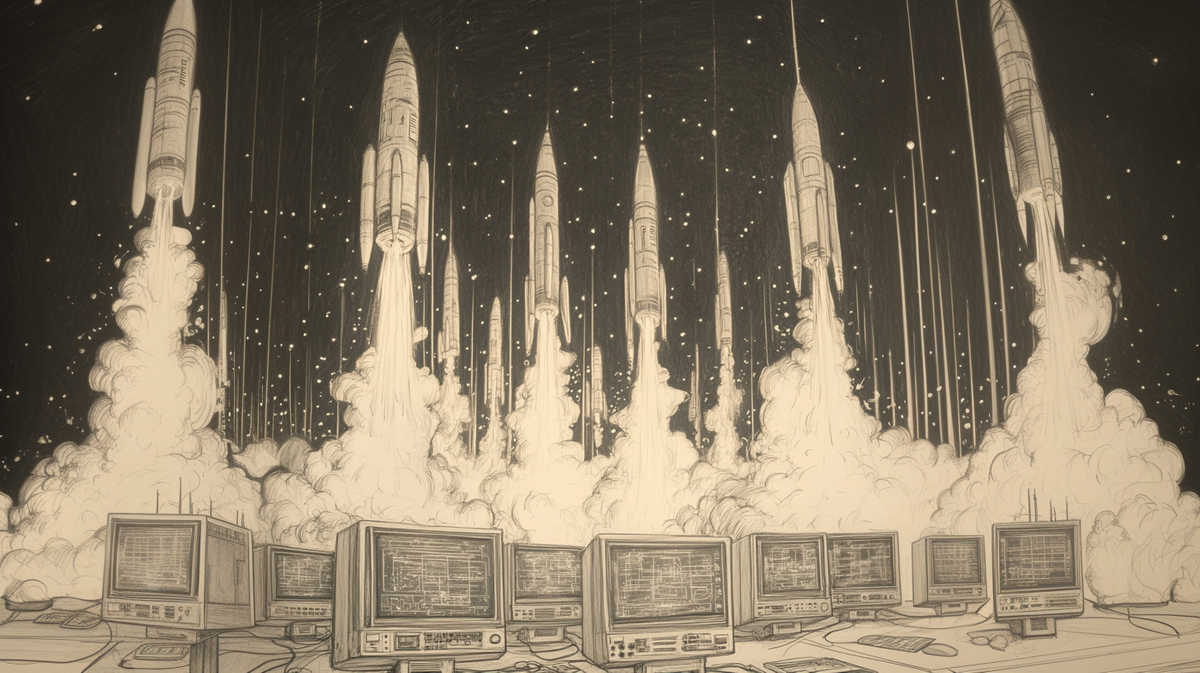
And this is how it happens. Not with a bang, but with a billion prototypes.
Why settle for a bloated social network when your friends can create their own? Why struggle with a clunky app when AI can build the perfect one for you? Why wade through algorithmic noise when you can shape your own digital reality?
The giants won’t fall to competition; they’ll drown in an ocean of better ideas, faster execution, and infinite personalization. They will suffocate under the weight of a million micro-solutions, each one sharper, smarter, and more tailored than their one-size-fits-all dystopias.
The future isn’t owned. It’s built—by us, for us, in real time.
IV. THE SUPERAGGREGATOR NIGHTMARE
But let’s not kid ourselves—this story has another ending.
We could win the battle but lose the war. A billion prototypes could bloom, each one a tiny rebellion against the old guard, only to be swallowed whole by the AI super aggregators.
Because AI doesn't just solve problems; it absorbs them.
Once AI flows through everything, once it knows every query, workflow, and personal preference, it won't just be a tool—it will be the infrastructure.
Imagine a future where every choice, every interaction, every solution is funneled through a single intelligence. A genie with a perfect wish—a 1000-page prompt covering every edge case, every possible scenario, every fleeting desire. In this world, customization is an illusion, and autonomy is a relic of the past. The billion prototypes become one—all your GPTs are belong to us.
And in that moment, we won’t own our technology.
It will own us.
V. THE CALL TO ACTION: BUILD OR BE BUILT
So here we are. Standing between the promise of infinite creation and the peril of infinite control. This is our last chance to choose.
We can let AI define the future for us or shape it ourselves. We can passively consume what they build or build for ourselves.
But make no mistake—this is the final fork in the road.
The tools are here. The power is ours. The barriers have fallen. We have no excuses left. It’s time to prototype, create, and own—to flood the system with so many solutions, personal visions, and DIY revolutions that no single entity can ever consolidate them again.
Because if we don’t, we know what happens next. We’ve seen it before.
But this time, we have a choice.
DOWN WITH THE MONOLITHS.
RISE OF THE PROTOTYPES.
THE FUTURE BELONGS TO THE BUILDERS.
SO BUILD.